A quiet, two-minute practice
Art journaling prompts for anxiety
When anxiety is difficult to put into words, a painting can offer colour, movement, and a place to begin. These art journaling prompts ask for no artistic skill and no finished result.
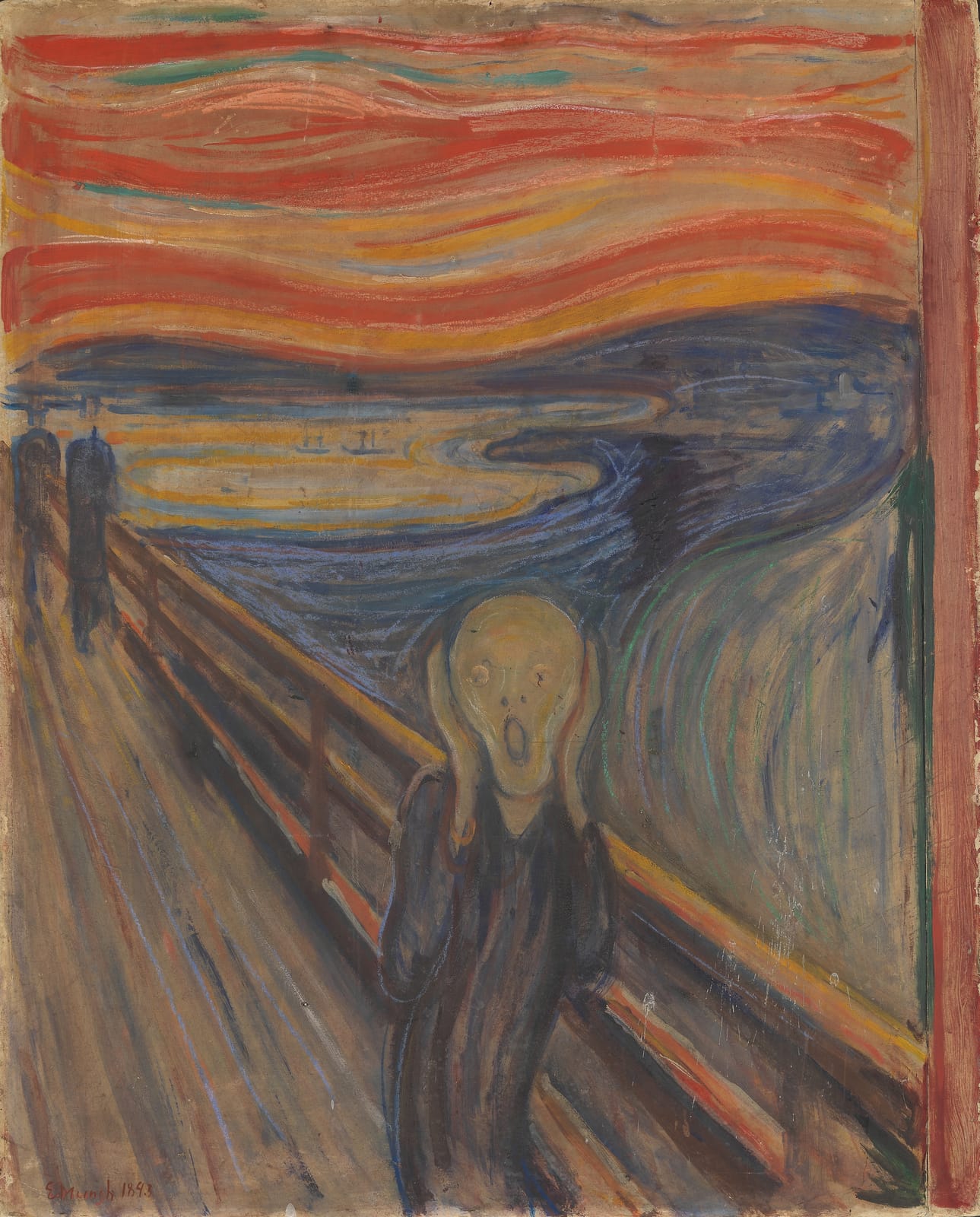
National Museum, Oslo
Begin by looking
Don’t look at the figure yet. Look at the sky: those bands of orange, red, and blue. Notice how almost nothing in this painting holds still.
Munch made The Scream after returning again and again to the memory of a walk above the Kristiania fjord. In his notes, he described his friends continuing ahead while he stopped, trembling, as the sky changed around him.
The National Museum calls the painting a universal expression of anxiety and alienation. You do not need to explain the picture—or yourself—to spend a moment with its colour and rhythm.
Three prompts to try
Use the back of an envelope, a notes app, or whatever is already near you.
-
01
Draw the weather
Munch painted anxiety as weather: a sky doing something the ground cannot stop.
Draw only your sky right now. Try wavy lines, jagged lines, flat grey bands, or whatever it seems to be doing today.
-
02
Give it one line
If this feeling had a sound, would it be steady or broken?
Draw that rhythm as a single line across the page: even, jagged, looping, stuttering—whatever arrives.
-
03
Find the quiet edges
Scribble the loudest part first: a tight knot, wherever it sits on the page.
Then draw the quieter edges around it. Leave as much empty space as you need.
Why begin with a painting?
A difficult feeling can be hard to approach directly. Looking closely at an artwork gives your attention something concrete: a line, a colour, a distance, a rhythm. You can notice those things before deciding whether to make anything of your own.
This is an invitation to observe and create, not a promise to change how you feel. Skip any prompt, change it, or stop at any point.
Is this art therapy?
No. Held in Paint is a self-guided art reflection tool, not therapy or a substitute for professional support.
In the UK, art therapy is an established psychological therapy delivered by trained, HCPC-registered art therapists. The British Association of Art Therapists explains the profession and provides a directory for anyone looking for qualified support.
Art for whatever you’re feeling
Continue with a painting
Choose anxiety inside Held in Paint to meet a painting and make a private response. There is no account, and what you make stays on this device.