Small ways into a blank page
15 gentle art journaling prompts for mental health
When words feel too direct—or do not arrive at all—colour, shape, and movement can offer another place to begin. These 15 gentle art journaling prompts need no artistic skill and no finished result.
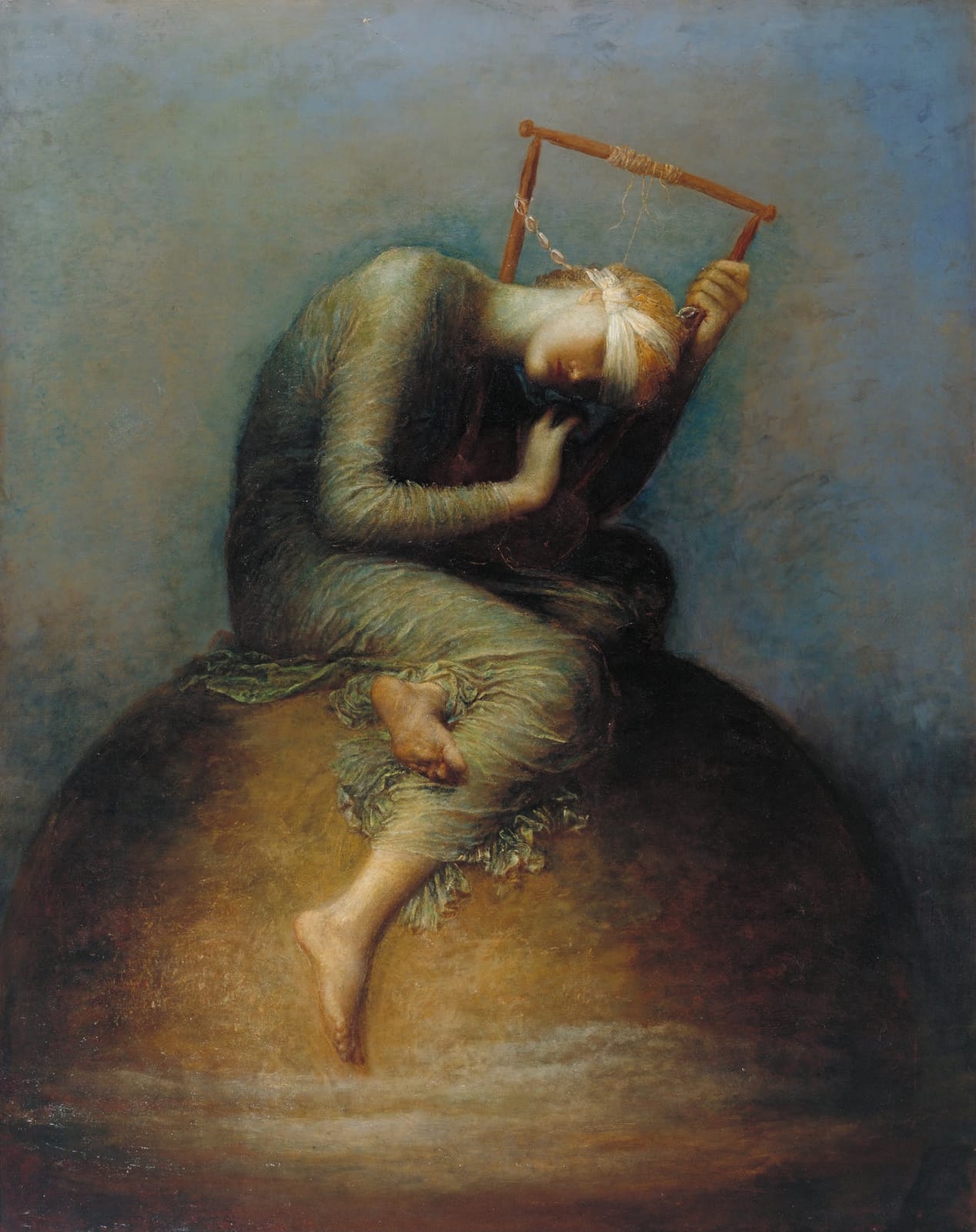
Tate Britain, London
Begin with what is still here
A blindfolded figure bends over a lyre. Nearly every string is broken, but one remains. Look at how closely she leans towards that small possibility of sound.
Watts places the figure on a globe beneath an almost empty sky. Her posture is tired rather than triumphant; the painting makes room for fragility without turning away from the one string that remains.
You do not need to feel hopeful, explain a feeling, or make something beautiful before you begin. Choose one prompt that seems possible today. Change it, leave it unfinished, or simply read it and stop.
15 gentle prompts to try
Use the back of an envelope, a notes app, or whatever is already near you.
-
01
Choose today’s three colours
Pick three colours without explaining why: one for what feels close, one for what feels far away, and one simply because you want it there.
Place them anywhere on the page as blocks, lines, dots, or overlapping patches.
-
02
Draw your inner weather
Draw weather without drawing a landscape. Try pressure, direction, empty space, repeated marks, or one cloud-like shape.
Let the page describe the weather without naming it.
-
03
Follow one line
Put the pen down and let one continuous line cross the page. Move quickly, slowly, heavily, or barely touch the paper.
Pause when the line seems to need a pause, then continue if you want to.
-
04
Give a feeling a shape
Choose one feeling that is present, even faintly. Draw it as a shape rather than a face or a scene.
Notice whether it has a hard edge, a soft edge, holes, layers, or space around it.
-
05
Make room around the noise
Make one dense patch of marks wherever the noise seems to belong on the page.
Then leave a generous margin of untouched paper around it.
-
06
Draw a small boundary
Draw a frame, circle, pocket, or uneven enclosure. Put one mark inside it and one mark outside it.
You can decide which side needs more room.
-
07
Collect five small comforts
Make five small boxes. In each one, draw, write, or paste something ordinary you like noticing: a cup, a colour, a texture, a song, a window.
Keep each box simple enough to finish in a few marks.
-
08
Make a page for one sound
Listen for one sound near you. Translate its rhythm into marks: repeated dashes, soft shading, gaps, loops, or dots.
Continue until the sound changes or you have had enough.
-
09
Set one thing down
Draw a shelf, bowl, table, or patch of ground. Add a symbol for one thing you would like to set down for the length of this exercise.
You do not need to solve it or pick it up again on the page.
-
10
Make an imperfect pattern
Repeat one simple mark across the page: a square, leaf, dash, spiral, or shape of your own.
Whenever the pattern changes by accident, let the new mark stay.
-
11
Draw near and far
Place one mark close to an edge and another far from it. Add more marks at different distances without making a picture.
Notice which parts of the page feel crowded and which have room.
-
12
Make a permission slip
Write the words ‘Today I may…’ and finish the sentence with something small: pause, change my mind, make a mess, ask, wait, or begin again.
Decorate only one word, or draw a border around the sentence.
-
13
Place one bright thing
Cover part of the page with the darker colour using any kind of marks.
Add one small bright mark wherever it seems least expected.
-
14
Draw what still has energy
Begin with the smallest mark you can comfortably make. Repeat it only while your hand wants to continue.
Let the marks grow, shrink, wander, or stop.
-
15
Leave something unfinished
Begin a shape, line, list, or patch of colour. Stop before it reaches the edge or closes itself.
Notice the open part, then put the materials down.
Why begin with an image?
A blank page can ask too much. A colour, line, shape, or detail from a painting gives attention something specific to meet before words are needed. The prompt offers a starting place, not an interpretation of you.
These exercises are invitations to observe and create, not promises to improve a feeling. If a prompt feels uncomfortable or makes the moment harder, skip it, change it, or stop.
Is this art therapy?
No. Held in Paint is a self-guided art reflection tool, not therapy or a substitute for professional support.
In the UK, art therapy is an established psychological therapy delivered by trained, HCPC-registered art therapists. The British Association of Art Therapists explains the profession and provides a directory for anyone looking for qualified support.
Art for whatever you’re feeling
Continue with a painting
Choose how you feel inside Held in Paint to meet a painting and make a private response. There is no account, and what you make stays on this device.